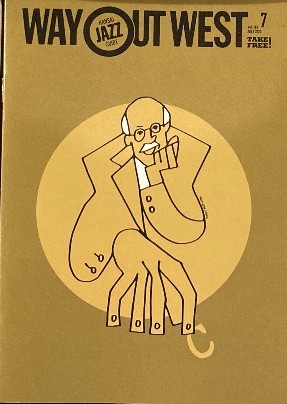
Hisayuki Terai
Originally published in Way Out West Magazine, 2022
日本語版はこちら
Interview
Takao Fujioka: You turned 70 this June, and at the same time marked the 50th anniversary of your professional debut. Could you tell us about any turning points or particularly memorable episodes along the way?
I’ve been devoted to Tommy Flanagan all my life, so I don’t really know what I’d call a turning point. But if I had to name one, perhaps it would be this: I first asked Tommy to take me on as a student in 1975, but he turned me down. I kept asking, and he finally accepted me in 1984. Even then, it took another five years before I could actually study with him, in 1989.
After one of Tommy’s concerts at OverSeas, Flanagan came to stay with us and worked with me until around three in the morning. It was August, and a typhoon was approaching. Tommy said, “What should I teach you first...? That’s it! Since there’s a storm coming tonight, let’s work on Tadd Dameron’s Smooth as the Wind.” He sat down at the piano and showed me how he played that signature ending.
From that night on, whenever I asked him a question, wherever we happened to be, he was willing to teach me anything. The trouble was, a genius like him couldn’t understand ordinary people like me. Even if I asked, “How did you play that part just now?” he’d say something like, “That part? Oh, I just played what you heard.”
Tommy is generally remembered as a gentle, refined gentleman. But that was the side he showed the world. In fact, I’ve never known anyone with a stronger will or a more fiery temperament.
At first, Flanagan used to tell me, “Don’t be a copycat. What’s the point of copying me?” But years later, when I saw him for the last time, I played one of his favorite tunes, Black and Tan Fantasy, and he praised me: “You’ve created a very good version.”
Late in his life, when Flanagan introduced me to Johnny Griffin, he said, “This guy can play everything in my repertoire. Do you have a student like that?”
That was the greatest compliment I could ever have received.
Your club, OverSeas, is now in its 44th year. Could you tell us about your commitment to maintaining a consistent musical style and performing exclusively at your own club, rather than elsewhere?
Ever since I discovered Tommy’s music as a student, he has been my god. If I were to define my own style, I’d call it Detroit Hard Bop Romanticism. My hands are too small to reproduce Tommy’s thick voicings exactly as he played them, but I’ve always taken to heart his advice: “Never leave out the root.”
I feel that Tommy’s playing carries the accent of his hometown, Detroit. My phrasing is influenced by Tommy’s prosody, but it naturally has a strong Osaka accent. I never lose sight of my Japanese identity. That’s why I don’t want to force blue notes into my playing. To stay true to my mentor and my musical integrity, I decided to play only at my own club, which I hope to make the ideal place to preserve this kind of music.
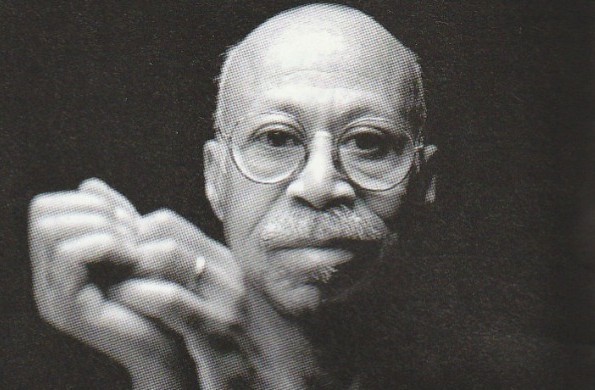
You recently took on solo piano for the first time, at the age of 70. What are your aspirations for the future, and what advice would you offer young musicians today?
As for my own aspirations, all I can do is keep refining what I’ve been doing. For a professional pianist, technical proficiency is a given. But technique isn’t just about nimble fingers. You must make your sound convey warmth and coldness, a whole range of colors, sweetness and bitterness—and even evoke aromas.
Through my conversations with my mentor, I acquired at least a small part of this kind of technique. That is the legacy he left me.
We live in an age when Japanese players have become stars in Major League Baseball and foreign-born sumo wrestlers have risen to the rank of yokozuna. That has led me to think, just a little, that perhaps a man from the Kansai region like me can carry on the authentic Detroit hard bop tradition.
Ever since my professional debut in Kitashinchi 50 years ago, whenever I earned a gig fee, I used the money to buy as many records as I could. I transcribed them and went to just about every concert by jazz musicians visiting Japan. I wasn’t alone in this; many aspiring jazz musicians did the same back then.
Today, you can easily listen to music from all over the world on YouTube and streaming services. While we have access to an enormous amount of information at the touch of a button, I can’t help feeling that our appreciation of great music—and the intensity and depth of the emotions it inspires—has diminished.
I really want young people to listen to as much good music as they can, and, above all, to hear it live. At OverSeas, students have always received a 50% discount on the live charge. And if there’s anything you want to know about jazz, Detroit hard bop, or Tommy Flanagan, come and see me.
I sometimes joke about this with Kawabata, who has been tuning my piano for more than 40 years: we don’t even know how much longer the piano as an instrument will exist in this world. Before long, every piano may be electronic, and real acoustic pianos may be found only in museums. I don’t know how much longer I’ll be able to play, either, so come and hear me while you still can!
Hisayuki Terai: A Musical Journey
Tommy Flanagan came to Japan with Ella Fitzgerald, serving as her musical director and pianist. On a mid winter day in Kyoto, before a concert by Ella and Flanagan trio, Terai waited, in the snow, for Flanagan at the stage door and asked him to take him on as a student. He politely declined, explaining that he was too busy with his own practice.
The concert that followed made a profound impression on Terai. Flanagan’s trio delivered a full 50-minute set of hard bop in its own right, drawing an ecstatic response from an audience that included many professional Japanese jazz musicians. The moment the opening notes of “Chelsea Bridge” from his album Overseas rang out, the hall erupted in applause and cheers. As soon as the trio finished its set, Ella took the stage and sang for some 70 minutes, with the audience clapping along in perfect time. The power of Flanagan’s playing, Ella’s performance, and the audience’s deep appreciation of the music strengthened Terai’s resolve to become a professional musician.
Terai persisted, asking Flanagan again over the following years.
At Flanagan’s invitation, Terai visited New York. During the trio’s two-week engagement at the Village Vanguard with George Mraz and Kenny Washington, he went to the club with Flanagan every night and watched the performances from the front row. Seeing Flanagan not only as a genius musician but also as a person left a lasting impression on him.
Tommy Flanagan: A Brief Introduction
Detroit
Born on March 16, 1930, in a Black neighborhood of Detroit, Michigan, Flanagan grew up in a city transformed by the booming automobile industry. The expanding industrial economy offered Black workers new opportunities for economic stability, even as racial discrimination remained deeply entrenched. At the same time, bebop was transforming jazz from popular entertainment into a highly sophisticated, uncompromising modern art form with profound expressive power—a development that had a great impact on young Flanagan.
Flanagan began working professionally in his mid-teens. After serving in the U.S. Army for two years during the Korean War, he returned to Detroit and joined the house band at the legendary Blue Bird Inn, led by tenor saxophonist Billy Mitchell, with Thad Jones serving as its de facto musical director on cornet and Elvin Jones on drums. The house band also shared the bandstand with many nationally renowned guest musicians, including Miles Davis and Sonny Stitt, whom Flanagan would later work with in New York. Flanagan and his fellow Detroit musicians helped shape a highly sophisticated local hard bop style. Much of the repertoire he developed during this period remained with him throughout his life, finding a special expression in his 1993 album Let's, a tribute to the music of Thad Jones.
As a sideman
Flanagan moved to New York in 1956 and was soon recording almost daily. He played on many classic albums, including Sonny Rollins’s Saxophone Colossus and John Coltrane’s Giant Steps. Many recording sessions in those days involved little rehearsal: after a brief discussion in the studio, the musicians would often record each tune in a single take. In 1957, he toured Sweden with J. J. Johnson’s quintet and recorded one of his early masterpieces, Overseas, there.
In the early 1960s, he joined Coleman Hawkins’s quartet and remained deeply devoted to Hawkins, both as a musician and as a person, until Hawkins’s death.
In 1968, Flanagan became Ella Fitzgerald’s musical director, touring the world while continuing to record under his own name. After a heart attack in 1978, he left Fitzgerald’s group and focused on his own career as a leader.
As a leader
After going independent, Flanagan released a series of piano-trio albums. No longer merely a sideman, he became a master admired in Europe, the United States, and Japan for his exquisite touch, refinement, and elegance. In 1990, he topped polls including DownBeat magazine’s readers’ poll. In 1993, he received Denmark’s Jazzpar Prize and used the prize money to record Let’s, a collection of Thad Jones compositions, at his own expense.
He died of a ruptured aortic aneurysm on November 16, 2001, having remained an active musician until the end.
Recommended recordings featured in the magazine
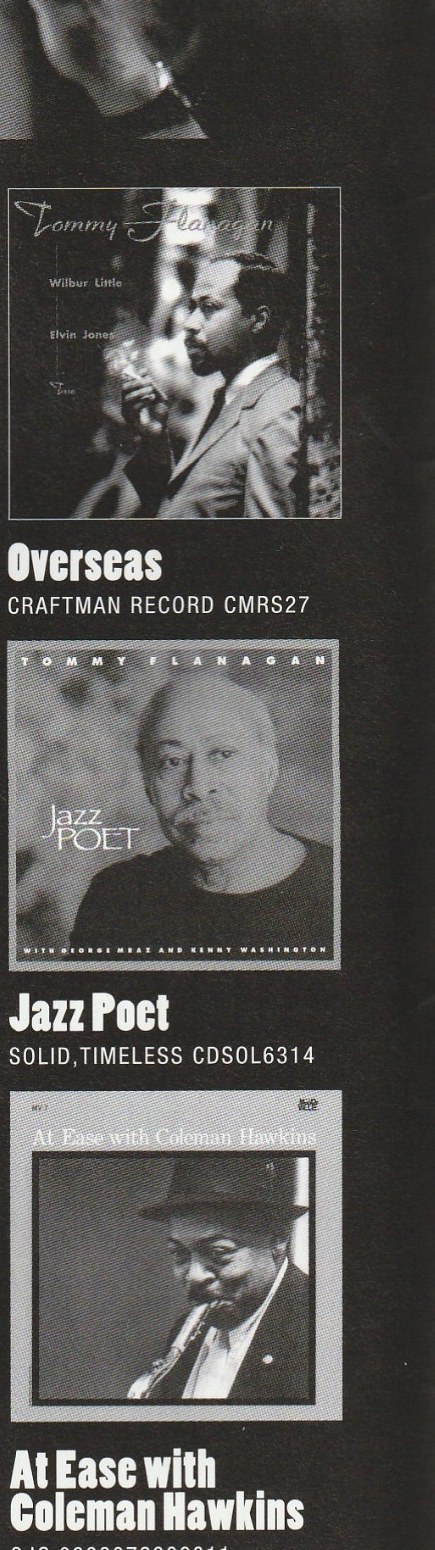
Tommy Flanagan — Overseas (CRAFTMAN RECORD CMSR27)
Tommy Flanagan — Jazz Poet (SOLID / TIMELESS CDSOL6314)
At Ease with Coleman Hawkins (OJC 0888072300811)